
Pyramid · Saqqara · Egypt
For centuries, Egyptian kings were buried in mastabas, low rectangular tombs built over underground burial chambers. They were substantial structures, but they were not pyramids. Then, during the reign of King Netjerikhet, sometime around 2650 BC, his tomb at Saqqara began to grow upwards. What started as a mastaba became six levels of stone rising about 60 metres above the desert, creating the first pyramid in Egypt.
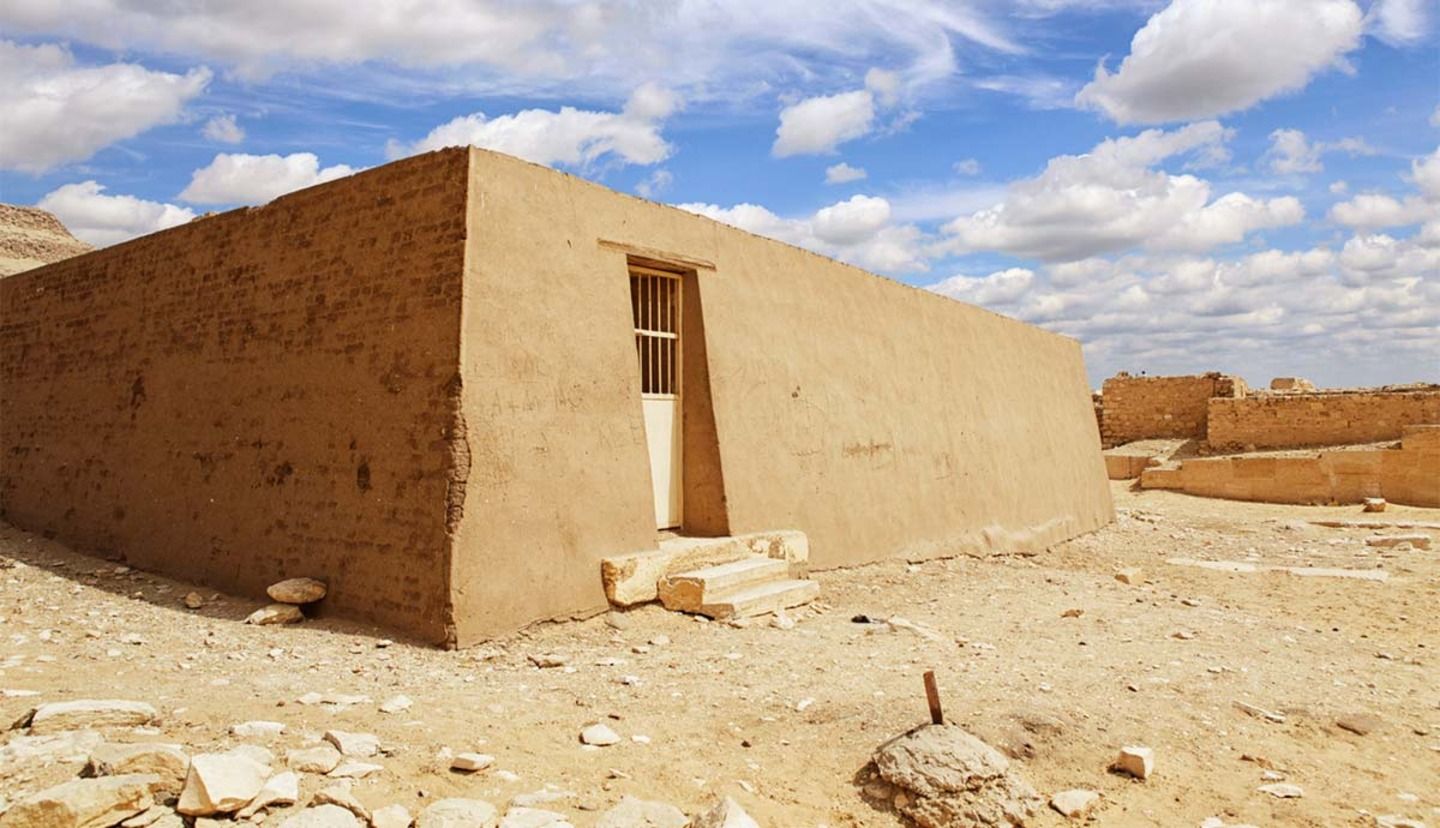
Mastaba image courtesy of The Collector
We know the king better by the name of Djoser. That name appears to have become associated with him later, while the monuments from his own reign identify him as Netjerikhet. His tomb began as a mastaba and was enlarged through several stages until the builders arrived at the six-stepped form we see today. The process matters because the Step Pyramid was not designed in its final form from the beginning. The builders kept changing the structure until a completely new type of royal monument emerged.
Building it required a new approach. Limestone was used on a scale that had not been attempted before, not just for the pyramid but throughout the complex around it. The builders carved columns, doorways and other details in stone to imitate structures that would normally have been made from wood and reeds. They were taking familiar royal architecture and making it permanent.
The Step Pyramid also extends deep below the ground. A central shaft descends about 28 metres to the king's burial chamber, while galleries, corridors and hundreds of rooms spread beneath the monument. The builders used granite and other fine stones in the underground chambers, and more than 40,000 stone vessels were found there, many bearing the names of earlier kings. Some of the burial apartments were lined with blue-green faience tiles made to imitate the reed matting of the royal palace. Reliefs show Djoser performing rituals connected to the Heb-Sed, the royal festival through which a king renewed his power.
The entire complex was built around the idea that the king's kingship would continue after death. Courtyards and shrines provided spaces for rituals, while the stepped form may have represented the king's ascent to the heavens. The exact symbolism is still debated, but the purpose of the complex was clear that Djoser's royal existence was meant to continue even after his burial.
The man traditionally credited with this transformation was Imhotep. He was a senior official under Netjerikhet and is later identified as the architect behind the Step Pyramid. His own titles place him close to the centre of royal administration, but his reputation grew far beyond his lifetime. Centuries later, he was remembered as a man of wisdom and healing and was eventually worshipped as a god. The Greeks associated him with Asclepius, their god of medicine.
There is a popular idea that Imhotep and Joseph, from the Bible, were actually the same person, but mainstream historians and Egyptologists do not accept that identification. The biggest problem is chronology. Imhotep lived during the Third Dynasty, around the 27th century BC, while the traditional biblical chronology places Joseph much later. There are similarities in the stories, but not enough historical evidence to turn them into the same person.
The pyramid was only the centre of a much larger complex. A limestone wall surrounded more than 35 acres, with one genuine entrance and fourteen false ones. Inside were courtyards, shrines, the South Tomb, ceremonial buildings and spaces associated with the king's Heb-Sed festival. Many of these structures were symbolic rather than practical, preserving in stone the forms of buildings and shrines that would normally have been temporary.
Saqqara would remain a burial ground for thousands of years after Djoser. It was the great necropolis of Memphis, the ancient capital of Egypt, and later generations continued to build tombs, pyramids and temples across the same landscape. The result is one of the richest archaeological sites in Egypt, with monuments from different periods sitting within the same desert. But the Step Pyramid remains the point where the story of the Egyptian pyramid takes its first major turn. A few generations later, Egyptian builders were experimenting with smooth-sided pyramids, eventually producing the monuments at Giza that became the image most people associate with ancient Egypt.
Before those pyramids, there was Djoser.
Saqqara is about 30 kilometres south of Cairo and is easy to visit by taxi, ride-hailing service or organised tour. It can be combined with Memphis and Dahshur if you want to follow the development of Egyptian pyramid building across several sites rather than visit the Step Pyramid on its own.
The Step Pyramid complex is part of the wider Saqqara archaeological site. Access arrangements and ticket prices can change, so check the Egyptian Ministry of Tourism and Antiquities before visiting.